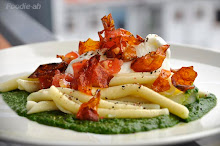
Getting to the more meaty part of the story, I like the dough that Nancy Silverton has created. Without a doubt, she has come up with an innovative, unique crust. Mario Batali, on the other hand, has complemented that with some American-Italian toppings. My favourite of all is the one with slow roasted tomatoes and burrata cheese, which I made replacing burrata with ricotta (se picture above) due to unavailability of burrata.
 As into bread making as I am, it is only logical that I wanted to try to reproduce this delicacy, and so I did. The real problem was that a proper recipe cannot be found. After searching through the net multiple times, I came to the conclusion that there is only one recipe published (2 posts with the same recipe: Pizza School, and Scuola di pizza), and it just doesn't work. I tried that recipe and it was nowhere near what you would have at Mozza. So I did further research, and watched numerous videos by Peter Reinhart on the quest for the perfect pizza. About 3 or 4 of them are dedicated to Mozza, and although there is no mentioning of the recipe which is of course a very well protected secret, I worked it out myself by combining bits of information from the Mozza pizza school, and the process used by the factory to produce Mozza's dough.
This dough contains a small amount of rye flour and wheat germ, which contribute to its distinct taste.

The following doses will produce 3 crusts:
POOLISH:
- 125g Bread Flour (in Singapore, I used Prima bread flour)
- 125ml Water
- 1 tiny pinch of dried yeast (about 0.5 grams)
- 250g bread flour
- 150ml Water
- 3g Brown rye flour
- 3g Wheat Germ (this can be found in organic products shops)
- 7g Kosher salt
 In a bowl, mix 150ml water together with all the flours, but do not add the salt. Once roughly combined, incorporate the poolish into the mixture, and knead using a dough mixer until gluten is almost fully developed. Then add the salt, dissolved into a very small amount of water (10ml will be sufficient) and continue to mix until you reach full gluten development. Use the windowpane technique to check.
Once completed, pull the dough out of the mixer and place it into a bowl. Let it rest for 15 -30 minutes, and it will be ready for shaping. Divide it into three chunks, and shape each one by dusting it into a very small amount of flour (just as much as you need for it not to stick to your fingers), and shape it into a ball by pulling the sides and folding them underneath it then pushing them into it. This operation must be repeated 5-6 times, and it is important to trap bubbles of air into your dough ball, so that you will get a nicely bloated crust once you bake your pizza.
 Put the dough balls into a container and tightly seal to prevent air from drying the surface. Place the dough balls in a cold area of your refrigerator and let them rest overnight. 12 to 24 hours later, pull the dough balls out of the fridge and let them rest outside for about 1 to 2 hours. Now they are ready for use. Shape them into a pizza by following the technique shown in this Mozza video. I recommend you finally place the stretched pizza on baking paper and put it into the oven with the paper, or else you will be likely to mess it up unless you have the right tools. In the video below, I filmed the shaping part and the condiment technique for the fennel and spring onions pizza. My video might help you see how this recipe's dough is supposed to behave during the stretching phase.
When it comes to the topping, needless to say that the combinations are unlimited. I made the first one with one of the Mozza classic toppings: cream, onions and spring onions, fennel, and mozzarella (I omitted the sausage as I didn't have one handy).
 The second was my favourite Mozza's topping, the slow roasted tomatoes and burrata one. I roasted the tomatoes for about 6 hours at 90C with some salt, thyme and oregano sprinkled on top.
 I prepared a base tomato sauce to dress the pizza so that the slow roasted tomatoes could be placed on top of it. To prepare the sauce, I heated some olive oil, added a tin of chopped Italian tomatoes, then cooked them for about 5 minutes with some salt, pepper and fresh basil.
 Finally, the cooking stage. The huge advantage of Mozza's pizza is that, unlike the classic Neapolitan pizza, it doesn't require an incredibly hot oven, and works well with longer cooking times. If your oven can reach about 250C, then you can cook this. Of course, you must have a refractive stone in order to have a crispy bottom like the one below (I purchased a lava stone from Hup Kiong cut to exactly the size of my oven, and it works wonders). Make sure that the stone is fully heated, and that will take at least 30 minutes of pre-heating at maximum temperature before you insert the pizza.
Now it's time to sit in front of your oven and watch the crust slowly blow and brown until ready!

 This is my recipe:
 Now the dough is ready for stretching. Remove the cling film, pat some flour around the dough and flatten it by pushing it with your fingers, until you obtain a flat "pizza" like shape. Do not stretch it or pull it at this point. Now lift the dough, and let it stretch naturally with its own weight, supporting it with your fists (like in the picture above). Keep stretching it, until you lave a large section in the middle that is paper-thin and transparent.
 Now the sheet is ready for laying on the tray. I used a non-stick pizza tray I bought in Cold Storage.
 Slowly fit it onto the tray, then cut the crescenza cheese into small pieces and scatter them around the perimeter and in the middle. I used about 100gr of crescenza for each focaccia. Repeat the same stretching exercise on a second piece of dough, then lay it on top of the other, and make the two stick around the edges.
 Finally, with the help of a rolling pin, cut the focaccia around the edges, and recollect the residual dough into a ball. It can be reused after resting for 2-3 hours in cling film to prevent it from drying out.
 I already blogged about Peposo, which I had at
  Sear the meat in a casserole until browned, then remove it from the heat, embed the sage, rosemary and black peppercorns, add the whole bulb of garlic, sprinkle with a couple of pinches of salt and pour the wine until the meat is completely covered. Put it in the oven at 150C covered with a lid and leave it there for 2 to 3 hours, until the meat is totally tender. Check it every hour to ensure that the meat is still covered by the wine. Finally, uncover it and let it continue until there is only about half a centimeter of juice left at the bottom of the casserole. Remove from the heat, let it cool and store in the fridge overnight if necessary.
 Make some pasta dough, as I described in
  Finally, for the sauce, you need some prime quality olive oil (not the sort that you buy in the supermarket!!). I used a premium Spanish olive oil:
  Simply boil the ravioli for 3 minutes, drain, then plate with grated Pecorino cheese, a cap of olive oil, and plenty of freshly grated peppercorns. Garnish with a sprig of sage, rosemary or thyme. This concoction of quality ingredients brought my palate straight back to Tuscany!
 We were visiting
  The restaurant is located just off the exit from the motorway, and it was extremely easy to find. Right at the entrance, there was a large brass emblem stating "Authentic Focaccia di Recco", to officialise the fact that there you can have the "real thing". There are in fact many places in Recco and its surrounding where you can have this type of focaccia, but of incomparable quality, to the point that you could call it a fake focaccia :) This is one of those incredibly simple dishes, so simple that it's very difficult to make properly.
 The restaurant has a beautiful dining room, warm and classic, and displays the most impeccable service that we encountered during our trip in Italy. As we sat down at our table, we were served a complimentary glass of prosecco, and a few slices of crispy bread. There were many interesting options on the menu, but without a doubt, the set menu was a must try, for 58 EUR per person.
 When they came with the appetiser, a real focaccia di Recco, we were terrified. The focaccia came on a trolley, laid on a wooden board, and it was probably 50-60cm in diameter, or in any case of a size that would have been sufficient for two people to eat and be fully satisfied. I initially thought we were going to be given a couple of slices and share the rest with other diners, but well... no, it was all for us!
 We were served three slices each, and the rest of the focaccia was left next to us, to continue to tempt us as we tasted the initial portion. This was without a doubt one of the best breads we had in our lifetime, but we were most inclined to think that it was the best. It was heavenly. The delicate crispiness, the softness and flavour of the cheese flowing from the inside. Unprecedented.
 The 'Polpo, brunoise di verdure e prescinseua su vellutata di melanzane' was an octopus salad with chopped vegetables and
  Less impressive was the 'Carpaccio di ricciola affumicato con pepe rosa e sale affumicato'. A carpaccio of amberjack, with pink peppercorns and smoked salt. The portion was huge and the fish was great, but the intense acidity of the sauce killed the delicate, tender fish. Finding the balance in salt and acidity on fish carpaccio is not simple, and it's not the first time I come across this problem.
 The meal was re-lifted by the 'Taglierini alle triglie di scoglio', which was a tagliolini with red mullet. The pasta had a good bite, and the flavour of red mullet was very distinct in the sauce. Well executed.
 The 'Corzetti dei Fieschi all'ortolana' was a
  The best of all dishes (leaving the focaccia aside) was this 'Pescatricie in sfoglia di melanzane su vellutata di pomodoro'. The rich meat of Monkfish was wrapped in tasty grilled aubergines, on a bed of mild tomato velvety sauce. This was our favourite overall, with an indisputably Italian combination of ingredients, and all the right flavours.
 The second main dish was a 'Fagottino di branzino in pasta Fillo con farcia di scampi'. Essentially a seabass with minced scampi, wrapped in filo pastry. This was also very good, and most notably the flavour of the scampi really added an extra kick to a seabass which has great texture, but is normally very plain tastewise. Despite how good it was, I was unable to finish this dish since every portion of this tasting menu was a full portion, in true Italian style. Unfortunately (or fortunately, perhaps), I am not used to eating at this rate, and I felt rather overwhelmed by the amount of food. The fought of having a dessert at that point was dreadful, and our waiter advised to wait 15 minutes or so, to recover.
  So we did, and went ahead with the desserts. Very good overall and quite classic, with a creamy/chocolaty dessert, and an orange creme bruleé.
 Manuelina is a must-visit if you are in the area: great Ligurian food, exceptional service and cozy setting made it a very pleasant evening for us. The focaccia is unmissable. There is a focacceria next door, where you can buy and eat exactly the same focaccia if you are not game for a full meal. However, the food at the restaurant is well worth the full experience.
  The Barucci family, owners of the Osteria, continue the tradition by serving classic Tuscan dishes, making use of their own garden grown vegetables. There is plenty to chose from on the menu, but the portions are very filling, so be cautious not to over order! We had 5 dishes for 2 people washed with plenty of Chianti wine, and for a total of 47 EUR it was a bargain.
 The classic unsalted Tuscan bread is served with Parmigiano Reggiano and olive oil. Generous spoonfuls of the cheese help adding flavour to the naturally insipid bread.
 The radicchio e pecorino con aceto balsamico was a very large portion, too large for one or even two people, so unfortunately I had to leave some on the side. This is just what it says on the label: radicchio, chunks of medium aged pecorino, and a balsamic dressing.
 Grilled vegetables are a classic antipasto throughout Italy. Here, they serve Melanzane grigliate al profumo di menta, which is grilled aubergines with mint. The large slices were nicely covered in dried herbs and spices, and paired nicely with the bread.
 I couldn't resist from ordering Pici once again. It is a type of pasta that is not commonly found outside of Tuscany, so every opportunity should be exploited. This was a truly rustic version, when compared to the ones I had at
  The main dishes were the forte of this place, and the reason why, I believe, it deserves a prawn on the guide. The Coniglio al tartufo was absolutely amazing. Slices of rabbit topped by a creamy truffle sauce, with slices of black truffle right on top. At 9.50 EUR, you can't really argue!
 Finally, the Cinghiale in umido con olive still remains one of the significant culinary memories I brought back from Tuscany. This stewed wild boar with black olives had such an intense meat flavour, you would never get from pork. This must be the first time I really appreciated wild boar meat. This is what Tuscany is about.
 The first bonus is the location of the restaurant, which is placed within a renovated farmhouse, on the edge of a hill, giving a spectacular view of Valdichiana. The building is made of the unique bricks that seem to characterise the whole village of Bettolle, which is about a kilometer from the restaurant. The brickwork can also be appreciated in the arches and ceilings within the restaurant. The combination of the scenic countryside view and the rustic architecture gave me more than ever a complete feel of being in Tuscany.
 While browsing through the menu, we were served a basket different varieties of homemade bread. This included the classic Tuscan unsalted bread, a couple of types of rolls, some focaccia and grissini. These were all fresh, and well accompanied with some locally produced olive oil of the highest standard, branded with the restaurant name itself.
 I stimulated my appetite with a Cinta senese marinata su misticanza con mele, noci e sedano. This was basically a porchetta made with the local pork (so called Cinta Senese), with a salad of celery, walnuts and black olives, and topped by a few chunks of lightly cooked, warm apple. The delicacy of this dish was outstanding, with every flavour on the plate gently emerging without dominating the rest.
 Impressed with the starter, I was eager to try the pasta. I ordered a Pici con guanciale, asparagi, fave e pecorino. Pici is a typical local pasta made of flour and water (egg is generally not added, hence, the white colour) and hand rolled into fairly thick and irregular sort of spaghetti. It is indeed that unevenness that makes this type of pasta taste so rustic. This recipe was of course a refined version than the Pici that you would have in a normal trattoria, but all the flavours were there, with the guanciale and pecorino playing the main role while asparagus and broad beans provided texture and variety to an otherwise common combination.
 One of the mains we had was the Costolette di agnello con mandorle, liquirizia e patate gratinate. The lamb was tender and cooked medium rare, but what really animated this dish was the licorice sauce. I never thought of licorice as an ingredient for meat sauces, but it did work perfectly. Such an inspiring combination, that I will probably try this at home, some day.
 The tagliata di vitellone al dragoncello con purea di cannellini e insalata verde was also well executed, with tender juicy veal accompanied by a fabulous pureé made from Cannellini beans. This is another inspiring element, so much that I bought some Cannellini while in Tuscany and brought them with me to Singapore to try this out.
 We had a selection of quality, hard Pecorino cheeses and a couple of soft goat cheeses, all served with Italian mostarda and honey.
 The least impressive of all courses was the dessert, which is often the case with Italian restaurants. It was a sort of soufflé with a cappuccino sauce on top. Quite nice, although not outstanding enough to make me finish it, after such a fulfilling meal.
 The total bill including wine was 76 EUR for two people, which makes this restaurant incredibly attractive considering the quality and amount of food, cozy setting and service overall.
 The interior was spacious but rustic, with various Tuscan style antiques laid around the entrance hall. The main dining room follows a more classic renaissance style and is more grand, as the name of the restaurant suggests.
  The most notable dish was the Tortelli di patate con ragú: potatoes filled ravioli in a tomato based ragu sauce. This is a typical peasant dish from Mugello, which represents an exception for a region that is most famous for its soups. This is what every diner shouldn't miss!
 Less distinguished was the grilled free range chicken with rosemary. Well executed with quality ingredients, but not something you could have in identical flavours elsewhere, including Singapore.
 I was far more impressed by the Peposo Imprunetino. The name of the dish derives from pepper, which is plenty in this dish, and Impruneta, which is where the dish is originally from. Impruneta is famous for producing bricks and terracotta ware. It is actually in the bricks furnace that this dish was originally invented. They used to put all the ingredients into the pot, leave it in a corner of the furnace for 5 hours or so, and the dish was ready. The predominant flavours were without a doubt the reduced Chianti wine and the black pepper. The flavours are extremely intense, and it's best eaten with accompanying bread.