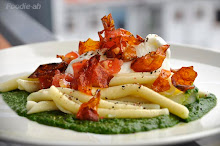
Mostly, ravioli are filled with ricotta cheese and spinach or various meats. I opted for a lighter, more subtle sea-bass ravioli, to be enjoyed with a flavoursome clam and fish sauce.

I therefore grabbed my motivation and decided to prepare some sea-bass ravioli this morning. Before heading out for my shopping, I prepared the dough using:
- 200g semolina flour
- 100g plain flour
- 3 medium eggs
- a pinch of salt
- a tablespoon of water

While the dough was resting, I went out to buy the following ingredients:
- 1 fresh sea bass
- Some breadcrumbs, or a slice of bread which you will soften in water or milk
- 1 egg
- Some herbs. I used parsley, fresh oregano and chives.
- Pink peppercorns, crushed

Steam the sea bass until cooked, remove the skin and separate out the meat. Finely chop the herbs, then mix with the sea bass meat, the egg, the breadcrumbs (or softened bread), and a pinch of salt. Mash gently using a fork, until you obtain a mixture that can be scooped into your ravioli.

Pull out the dough from the fridge and roll into thin sheets using a pasta machine. These need to be thinner than you would roll if you were making tagliatelle, as you don't want your ravioli to feel "doughy". I used a raviolatrice (see picture) to fill my ravioli, but you can easily make them one by one by hand, it just takes a little longer.

I made the accompanying sauce with a 50-50 clam and fish stock reduction as I had these two ready made in my freezer. Make the sauce by mixing in equal parts clam and fish stock in a frying pan together with a few tablespoons of tomato water and reducing on medium heat with a lemon zest and a sprinkle of breadcrumbs. Reduce until the sauce reaches the right level of thickness, then remove from the heat.
Tomato water: to make tomato water, blend a couple of fresh tomatoes, wrap the blended pulp into a cheese cloth and place onto a colander on top of a bowl. The tomato water will slowly drip over an hour or two.
Clam stock: simply sauteé the clams until they open up and release their juice, then separate the clam juice out.
Fish stock: Simmer the bones and of the fish over slow heat together with an onion, a stalk of celery, some button mushrooms, and preferably some fennel and fresh parsley. The stock will be ready after about 40 minutes.

Finally, boil the ravioli for a couple of minutes in a large pot of water, drain them out of their water and place on high heat into the frying pan together with the sauce. Sauteé for a couple of minutes, basting them with their own sauce, then remove from the fire and top with some delicate extra virgin olive oil. The ravioli are ready to be served.

 This is what I used to make this pasta:
 Preparation steps:


 The Pomodorini del Piennolo are one of the best varieties of Italian tomatoes, originating from the
  This was the perfect opportunity to pair a batch of Paccheri di Gragnano I have been storing for some time, with these beautiful tomatoes, grown form a nearby area.
 I used a few simple ingredients:
 Heat some olive oil in a frying pan, and add the squashed garlic and bay leaves (I also added some chilli flakes for a bit of heat). Once the garlic is golden, carefully add the crab meat, lightly toss it for 30 seconds, then add the white wine and let evaporate.
When the crab meat is cooked, remove it from the pan together with the garlic, which you will discard. Set the crab meat aside in a small bowl. In the meantime, you will have boiled and salted some water for the pasta. Put the Paccheri in the boiling water, as they will need about 12 minutes to cook.
Heat some olive oil in a frying pan, and add the squashed garlic and bay leaves (I also added some chilli flakes for a bit of heat). Once the garlic is golden, carefully add the crab meat, lightly toss it for 30 seconds, then add the white wine and let evaporate.
When the crab meat is cooked, remove it from the pan together with the garlic, which you will discard. Set the crab meat aside in a small bowl. In the meantime, you will have boiled and salted some water for the pasta. Put the Paccheri in the boiling water, as they will need about 12 minutes to cook. Finally,
add some of the basil leaves together with the remaining tomatoes, salt as needed and lightly toss for a couple of minutes. Add the crab meat and the remaining basil, followed by the Paccheri pasta when ready, and sauteé all together for a few seconds. Top with a dash of light extra virgin olive oil and serve with a fresh basil leaf.
Finally,
add some of the basil leaves together with the remaining tomatoes, salt as needed and lightly toss for a couple of minutes. Add the crab meat and the remaining basil, followed by the Paccheri pasta when ready, and sauteé all together for a few seconds. Top with a dash of light extra virgin olive oil and serve with a fresh basil leaf.
 These are the ingredients I dug out of my fridge to make this pasta:
 The preparation is very simple. Dice the guanciale and the wild boar salami (of course, you can use normal pork salami as wild boar cannot easily be found in Singapore).
 Chop very finely the carrot spring onions (I used spring onions as that's what I had in the fridge, but onions or leeks will be equally good), and celery.
 I was pretty excited to open the box of this mini burrata, produced in Puglia by
  I love this moment, cutting through the outer "sack" of the burrata, watching the cream leaking out first, followed by oozing clots of burrata. beautiful. Of course, I couldn't resist from having some of this before finishing my pasta. I wouldn't put all of it on the bucatini anyway.
 Start off by frying the guanciale in olive oil, and once well browned, add the carrots, celery and spring onions.
 Add a splash of red wine (a third of a glass) and quickly let evaporate on high heat. Once well evaporated, add the chicken stock, and simmer over medium heat.
 Once the chicken stock is half absorbed, add about 3 whole canned plum tomatoes and chop them directly in the sauce while stirring. Keep reducing over low heat and add salt and a small pinch of sugar should the tomato be excessively sour. Keep adjusting as you go.
 In the meantime, boil some water in a large pot, salt it and add the bucatini. They usually take 10-12 minutes to cook. Continue to cook the sauce, and after about 8 minutes from adding the tomatoes, add a few sprigs of thyme and if necessary top up the sauce with some of the boiling water from the pasta pot in order to prevent it from drying out. Let the thyme release its flavour into the sauce over low heat.
 Drain the bucatini once ready, then toss into the sauce pan and serve into serving bowls. Top up with some fresh burrata cheese, grated black pepper, and a drizzle of real extra virgin olive oil (proper strong, full flavour. I used a Sicilian one here, which is sold at
  I combined three types of onions: leek and shallots to sweeten the sauce and fresh chives to give it a bit of a zest (the thin, western type, not the Chinese chives). I combined those with some guanciale and Tuscan pecorino cheese to give the sauce body and flavour, and some local kai lan to add some green aspect to the dish and give it that tad of bitterness.
 I still had a pack of pici that I bought in Tuscany, so instead of making them myself, I used the pre-packaged ones, missing some of the fun. I still prefer handmade pici, as I like them irregular in shape and thickness. This is a rustic pasta, and it's not supposed to be perfect!
 I sliced the leek in fairly thick slices, then the shallots in thin strips and finally the chopped the chives very finely. I roughly cut the guanciale in 1-2 cm pieces, and detached the leaves from the kai lan, discarding the stems.
 After frying the guanciale for a couple of minutes in extra virgin olive oil, I added the shallots and leek and browned them. I then removed the leek and set it aside, to maintain it slightly undercooked and also to use it for later decoration on top of the pasta. I added about 100ml of chicken stock and reduced it with the rest of the ingredients, while the pici were boiling in salted water.
 Once the pici were ready, I tossed the kai lan leaves and half of the chives into the sauce, added the pici and sauteed them all together for about 30 seconds.
 I then arranged the pici into solid olive wood bowls, and topped them with the leeks, the remaining chives, some grated pecorino cheese, freshly ground pink, white and black pepper, and a drizzle of Tuscan extra virgin olive oil.
 The quality Tuscan olive oil brought together this dish with its earthy, green flavours. I want Tuscany, all over again.
 I already blogged about Peposo, which I had at
  Sear the meat in a casserole until browned, then remove it from the heat, embed the sage, rosemary and black peppercorns, add the whole bulb of garlic, sprinkle with a couple of pinches of salt and pour the wine until the meat is completely covered. Put it in the oven at 150C covered with a lid and leave it there for 2 to 3 hours, until the meat is totally tender. Check it every hour to ensure that the meat is still covered by the wine. Finally, uncover it and let it continue until there is only about half a centimeter of juice left at the bottom of the casserole. Remove from the heat, let it cool and store in the fridge overnight if necessary.
 Make some pasta dough, as I described in
  Finally, for the sauce, you need some prime quality olive oil (not the sort that you buy in the supermarket!!). I used a premium Spanish olive oil:
  Simply boil the ravioli for 3 minutes, drain, then plate with grated Pecorino cheese, a cap of olive oil, and plenty of freshly grated peppercorns. Garnish with a sprig of sage, rosemary or thyme. This concoction of quality ingredients brought my palate straight back to Tuscany!
 I have been keeping a pack of sun dried tomatoes which I bought in Italy over a year ago, since I never found the inspiration to prepare them. Today, having limited ingredients for the seasoning, I decided to bring them back to life. To do that, I brought some water with a dash of vinegar to the boil and kept the tomatoes in the boiling water for about 10 minutes.
 I then let the tomatoes rest on an absorbent surface and squeezed any excess water out of them. I vacuum packed and froze most of the batch, and kept about 4 of them aside to cook this pasta for 2.
 Remove head and tail from the sanma, remove the innards and discard them, debone it and put bones, head, tail, the carrot, onion and herbs into a skillet and bring it to a slow simmer. Keep this simmering for over 20 minutes to create the base for your pasta.
 In the meantime, wash your basil leaves and blanch them for 10 seconds in a large pot of boiling water. Remove them from the pot and immediately soak them into ice water. Gently squeeze all excess water, then put into a container together with the sun dried tomatoes, and half a garlic clove, finely chopped. Top with a drizzle of olive oil, then gently mash with an immersion blender until you obtain a paste that is not too fine.
 Add some freshly ground pepper to your paste, and there should be no need to add salt since generally sun dried tomatoes are already very salty. Bring a large pot of water to the boil, ready for your pasta, do not salt the water and add the linguini (which should usually take about 10-11 minutes to cook). Wash your fish fillets, pat dry them and sprinkle them with salt. Lightly pan fry them on a large frying pan on both sides in abundant olive oil, then remove them and set them aside.
 Deglaze the pan with half a glass of white wine. Once the wine evaporates, you should obtain a thick sauce as shown in the picture below. Now your pasta should be almost ready to be removed from the water. Make sure that you drain it 2 minutes before it's ready.
  Add some of the simmering stock to your frying pan, put in the pasta and lightly salt (do not fully salt the pasta, to counter-balance the salty paste that you will combine later) and simmer until the stock is absorbed and your pasta is al dente. When the pasta is ready, remove it from the fire and rapidly stir-in some of the basil-tomato paste.
 Arrange on serving plates, topped up with your sanma fillets (filetti di aguglia), and some freshly ground peppercorns. Enjoy the powerful aromas of basil and sun dried tomatoes!


 The idea is to make a mild tomato sauce, enriched with a fish fumet done on the spot. You can of course use other fish, and red mullets (in Italian - triglie) would be ideal for this dish, but I couldn't find them at the market, so I replaced them with red sea breams.
 The ingredients for this recipe are: