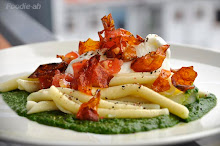
I have been dreaming of making Croxetti pasta ever since I saw it illustrated on an Italian cooking book. I never heard about Croxetti (or Corzetti) before reading that recipe, since this is a regional dish of Liguria and cannot be found outside of it. This is why I couldn't get hold of the mold required to make them, despite my previous attempts, which also involved my mother looking for them in Italy.

My trip to Liguria was an unmissable opportunity to taste the dish and find the tool required to make it. I was under the impression that these molds could be commonly found anywhere in the region, but as I asked people, I discovered that actually this dish is rarer than I thought, and there is only one carpenter left, named Pietro Picetti, who is still dedicated to maintaining the tradition. I managed to find out his location and headed off looking for him in the small town of
Varese Ligure. Without a specific address, I was given a description of the site of his workshop, and with my fingers crossed, hoping that the man would be there at the time of my visit, I drove to the town determined to find him.

With great relief, as I spotted the entrance to his workshop, the door was open, displaying a large Italian welcome sign. I opened the conversation informing him that I am based in Singapore and I went all the way to Varese Ligure to buy some of his croxetti molds. He wasn't surprised at all. He humbly explained that he has a constant flow of visitors from all over the world, in particular Japan, who travel from far away to this small town to get their hands on his work. He showed me the orders from American and Japanese culinary schools, and told me how once he was handed over a business card by one of his Japanese visitors, only to realise a few days later that he was actually the ambassador of Japan.

We then spent some time designing my personalised mold, and he showed me the original wooden molds from his great grandfather, who used to be in exactly the same trade (see picture below). Some of them are cracked, others have been slightly damaged by termites, and you can sense that these pieces are over a hundred years old. His designs are still based on the original designs from his great grandfather: wheatears, stars, crosses, olive leaves, and of course the initials of the owners, or the names of the restaurants.

Besides ordering a custom made mold, I also bought a couple of ready made ones. One in beech, and the other one in walnut. The first has two different star symbols on each side. This is a reproduction of the original mold passed to him by his great grandfather. The second one represents a sun surrounded by wheatears.

I was amazed by the beautiful designs, and the richness of detail. Just looking at them brought thoughts of the middle ages, the powerful families and their attachment to their own emblems, to the extent that they used to engrave them even into their food. Such intricate patterns, once printed into the dough, make its surface uneven, enhancing its ability to absorb pasta sauce. In Liguria, croxetti are traditionally eaten with a pine nuts sauce, pesto, or a tomato sauce. The recipes for the dough and the sauces are handed over by the man to all his customers, as he is keen to spread and maintain the tradition of the original sauces.

All molds are autographed by their creator on the cutting side - it states "
Pietro Picetti made this in Varese Ligure". The experience of buying an utensil directly from the artisan made me reflect on the value of what we buy. Nowadays we are all so used to shop around, find what we like, on a shelf and buy it. I must admit that buying from the artisan evokes completely different emotions. You are not just given an utensil, but also the history of it, and the passion that went into it. The value of what you buy becomes priceless, since it is not just a commercial item - it has been uniquely crafted by an artisan.

These wooden molds serve the purpose of cutting and shaping the croxetti. The bottom of each mold is very sharp, and is used to cut out a circle of dough from a 2.5 mm sheet. The circle is then placed inbetween the two pieces of wood, and compressed so that the drawings remain engraved into both sides of it - just like a coin.

Pietro also recommended a place where I could stop for lunch and have the traditional Croxetti from Varese Ligure. The restaurant is within a hotel called "Albergo Amici", located a 5 minutes walk from Pietro's workshop. I had a portion of delicious Croxetti with pine nuts sauce. I loved the texture of this pasta, very firm and rustic, paired with a flavorful nutty and herby sauce. It goes without saying that every single medallion I ate was imprinted with a drawing made by Pietro specifically for that restaurant.
A video of Pietro Picetti on the topic can be found on
YouTube.

 I started off with Polpo al vapore con salsa Ponzu, olio al prezzemolo e patate. This dish was the most delicate I had during my trip to Italy, but it tasted more Japanese than Italian. As I savoured it, the subtle dashi flavour immediately brought me back to the experiences of Kaiseki during my trips to Japan.
 The Pasta alla chitarra con profumo di pino, astice e patate was pretty good, seasoned with a delicate lobster broth and small chunks of potatoes. What I liked the most of this pasta was its very firm texture.
 Now the most amazing of all, and without a doubt one of the top pastas I have eaten in my whole life. The Spaghetti Faella con Guanciale "Parisi", cipolla e pecorino was an incredibly simple spaghetti dish, seasoned with various types of onion (red, yellow, white, leeek and chives), an extremely good guanciale (from Paolo Parisi). It is hard to describe how simply tasteful and delicate this was, but clearly the quality of the ingredients is key to the success of such a dish. This is what made me come back to this restaurant the next day, and it was the only "repeat" of my trip to Italy.
 The Piccione arrosto con spezie dell'Osteria e coulis di frutta was another hit. The crispy coating gave variety of texture and flavour to the dish, while the fruity coulis added the tang required to break the 'gamyness' of it all.
 The Insalata di lingua con salsa antica e pomodori cuore marinati in birra e cipolla was a very light salad with quality fresh vegetables, very thin slices of cow's tongue and little chunks of its cooking gelatin. A well executed, enjoyable salad.
 We were too full and decided to share a single dessert: the Mousse di mascarpone com crema al caffé, gelato di amaretto e albicocche confit was divine. A dome of mascarpone mousse was sitting next to a gelato made from amaretto biscuits, on a bed of coffee sauce. The apricot confit, together with a couple of mint leaves, were a nice touch to break the richness of the flavours.
 The summary is that if you happen to visit Siena this is without a doubt a must try restaurant, and considering that it's so easy to find, I don't see why not. The place tends to get busy, especially at weekends, so a booking hopefully one day in advance would be advisable to secure a table.
 Visiting Toscana and Liguria, the lands of olive oil, it felt natural to buy some olive wood utensils, such as this bread tray. This is ideal to let my focaccias and loaves rest just after baking, letting plenty of air circulate below the bread.
 I love the beautiful veins of the wood that show on these olive wood bowls. These are all one piece, carved out of a log. All these utensils have been treated with oil, so that they won't absorb any more liquid during their use.
 I have been looking for terracotta pots for the longest time, but unfortunately they are hard to find in Singapore. I bought this set of pots that are originally from Siena (
 I love ravioli, but what discourages me from making them regularly is the amount of work required to assemble them one by one. Making the filling and the dough is not a big deal, but cutting the sheets and sticking them together with the filling does take some time, if you intend to make a few dozens of them. I didn't need to think twice when I bought this ravioli making mould to make that process a breeze. The good thing is that the mould is designed for large ravioli, just the way I like them. I am looking forward to try this out!
 One of the things I will never forget is visiting my grandmother in Abruzzo and having her "pasta alla chitarra", very rich in egg yolks, and dressed with her tomato sauce, made of her own home grown tomatoes. I still remember her using this tool, which is rather hard to find outside of Italy. It wasn't the cheapest buy, but worthwhile having, as it felt like buying a piece of tradition. The tool can be used both sides, to make thin tagliolini, or wider fettuccine.
 This tool is called chitarra, which in Italian means guitar. The reason is pretty straightforward, given that it's a set of strings mounted onto a wooden frame, just like the well known music instrument. Once you lay the thin sheet of dough, a gentle roll over it is sufficient to cut it into perfectly regular tagliolini, which will have that characteristic square section.
 I tried this recipes a couple of times, and although the first attempt was already pretty good, it got better and better. At my third attempt, it came out so well that it was devoured in no time by my guests. In a way, it put the rest of the meal to shy :(
 I decided to make 2 different fougasses, one with anchovies and capers, and one with sun dried tomatoes. Following, the recipe I used, which I derived from the great book
  Ingredients for the Pâte Frementée:
 Ingredients for the main dough:
 I visited their branch located at the 4th floor of City Square Mall. The deco is very well done, with a combination of both modern and classic touches. The walls made up of baskets stand out, as well as the circular motifs around the tables that face the windows.
 The Shanghai pan fried dumplings ($5.00) looked a lot better on the menu than they did on the plate. The filling is tasty and releases juice once you bite into the dumpling. The skin was quite disappointing, as it tasted like the typical frozen gyoza you have in most cheap Japanese restaurants. On top of that, the crispy side was too soft and soggy for my liking.
 The dish I enjoyed the most was the Crabmeat and pork steamed buns ($9.00). Used to the usual xiaolongbao with pork, this was a refreshing variation to the classic pork filling. I liked the crab texture and delicate flavour of the seafood stock.
 One of their signature dishes is without a doubt this Shanghai specialty: the King Sized Nanxiang Crab Roe Steamed Soup bun (6.80). In this case, the bun really just serves the function of holding the steaming hot soup rich with bits of crab roe, which you can pull up by sucking on the straw.
 Maybe I'm pretty picky when it comes to zhajiang mien ($7.80), but this was one of the worst I had in Singapore. Most noticeably, what is served is not what's pictured in the menu. The picture shows the tytpical zhajiang mien, with its dense sauce on top. The noodles I was served just had some dry braised pork on top, with some liquid sauce sitting at the bottom. The worst part was that it tasted like what you would be served in a food court. Nothing like the rich and complex flavour of a proper zhajiang mien as it really lacked of a few dimensions.
 The same could be said for these beans ($9.80). The worst I had in Singapore, and they also lacked of a tad of salty, or a tad of meaty, or sweet, but anyway something to lift the dish, which had a strong flavour of uncooked beans. It is actually hard to get it so wrong. Quite disappointing.
 The beautiful interior, which overlooks the inside of the Marina Bay Sands shopping area, is cozy and softly lit. The wooden fired oven stands out behind the busy, dough-manipulating chefs.
 The pizza with oven roasted tomatoes, burrata and oregano was by far the best. With a truly simple, fresh and distinct Italian flavour, this pizza stood out from the rest. The straight flavour really brings out the deliciousness of the dough. I will definitely go back for this!
 The pizza with fennel sausage, cream and scallions was my wife's favourite. What is common to all the pizzas is the special "Mozza" dough they use. The pizza base is extremely thin and crispy, while the crust is very thick, fat, crispy outside and soft and airy within. The border of the pizza is lightly brushed with olive oil, which gives it that shine and crispness that is unique to Mozza.
 The tomato, mozzarella, Parma ham and rocket is an all time classic. The ingrediends were all of good quality, although this was not the best I have eaten of this kind. A more generous dose of mozzarella would have helped bringing this together.