Sunday, August 15, 2010

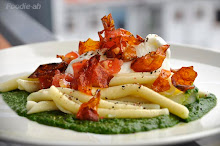
Strozzapreti alla Caprese

I like recipes that are created out of craves, when the ingredients are selected out what's available or what you really want to have. That has been the case with my past few pasta recipes, and definitely the case with this one. I was looking for a more robust texture, so I chose these strozzapreti "Rustichella d' abruzzo", which you can find at Liang Court.

I was craving again for these Italian fresh tomatoes which I blogged about in my previous few posts, and I wanted to make good use of my ever growing basil plants. I decided to combine these classic Italian flavours into a new pasta recipe, which I called "Caprese" for obvious reasons.

For this recipe (2 servings) you will need:

  • 8 Italian mini plum tomatoes
  • 170g pasta
  • A lot of fresh basil (about 2 packs if you are buying it from the supermarket)
  • 180ml chicken stock
  • Some fresh buffalo mozzarella
  • Garlic
  • Pink peppercorns
  • 6 fresh green peppercorns (optional)

As described on my previous recipes, remove the skin from the tomatoes by making a superficial incision on them (I cut a cross at the bottom of each tomato), then blanching them in boiling water for about 20 seconds and then immediately placing them into ice water. The skin should break apart and come off easily. Reserve the skin, then deep fry it in a small skillet where you have brought hot oil to the right temperature (about 180C). Remove the tomato skin from the oil when it starts to darken, dry out and crisp. Wrap it loosely into a couple of sheets of kitchen paper, which you then seal with your hands and shake repeatedly to let the oil be absorbed by it. Set aside.

Chop the plum tomatoes into small dices (about 6-8 pieces per tomato), then sprinkle with salt and set aside.

Blanch the basil in boiling water for 15 seconds, then again in ice water. drain it well, place it into a tall container with a tiny amount of finely chopped garlic, optional green peppercorns and some salt. Pout 2 tablespoons of extra virgin olive oil, then whizz with an immersion blender for a good 5 minutes, until it is reduced to a smooth cream of basil. You might need to add some olive oil to reach the right texture, but the end result should be solid and not viscous.

While the pasta is boiling, heat up some extra virgin olive oil in a large 28cm frying pan, fry 3 squashed garlic cloves until golden, then remove them. Add the stock, cover immediately and remove from the heat. When the strozzapreti are almost ready (I counted 12 minutes), put the frying pan back on the fire, drain the pasta and pour it into the frying pan together with 1 tsp of salt. Saute' the strozzapreti for a couple of minutes, until the stock is absorbed and you are left with a few tablespoons of sauce at the bottom of the pan.

Finally, arrange the basil cream circularly at the bottom of a warm plate, place the strozzapreti in the centre, then top with a chuck of buffalo mozzarella, the diced fresh tomatoes and the tomato skins. Pour a tablespoon of the sauce left in the pan onto each serving, then sprinkle with the crushed pink peppercorns and serve hot.

Saturday, August 14, 2010

FiftyThree - Lunch #2

I have already reviewed this restaurant a few months ago, but I decided to go back to have another taste their great bread and barley butter.

I once again decided to have the 3 set course lunch priced $53 (what a coincidence!). The items on the menu were more or less unchanged as last time I visited it, and I was glad that the bread was exactly the same, since this is what I went for! We had a double portion of the milk and charcoal bread. Filling, but well worth it!

Presentation is always great at FiftyThree. This appetizer was beautifully presented in syntony with their "nature theme". I liked the walnut cream and the crab meat, although I left most of the apple slices since I preferred the crab simply on its own.

The beef was absolutely great, tender and juicy, and the sauce was poured onto it right at the table.

We had the lamb again since we liked it last time: a rare lamb rump cut into juicy slices, arranged below thin and crispy slices of radish.

We also repeated the dessert, since it was one of the two reasons for coming back. Pretty high-calories, but well worth it.

This second visit at FiftyThree demonstrated that they have been so far very consistent with their food. The menu seems to remain unchanged, but on the other hand, if this is the food you come for, at least you are guaranteed to find what you like, and that you won't be disappointed due to lack of consistency.

Fiftythree
53 Armenian Street
Tel: 6334 5535
Website: http://www.blogger.com/www.fiftythree.com.sg

Thursday, August 12, 2010

Pavé

Pavé is now CLOSED.

When something is done with love and passion, it can hardly go wrong. That is the case with Pavé, the next kid on the block when it comes to patisserie in Singapore.


Quite a few patisseries opened recently in Katong, within a fairly small area. I can list a few, in chronological order: Gobi, Obolo, Indulgence, Temptations, Awfully Chocolate, and now Pavé. While Awfully chocolate aims at the mass market and its success is primarily based on its marketing rather than the product, the other patisseries do try to deliver a good product. So what distinguishes Pavé from the rest?

To me, it is quite obvious at a first glance, as you look at the display from outside. The shop provides a full experience from the moment you step in, with its pastel colours and cozy design. It's like stepping into someone's house, except you are in a fairy tale. All the friendly staff working at Pavé are in there for the passion rather than the money. They know the product, and they love talking about patisserie.

Pavé has only been open for less than a week, and the first experimental batch of desserts is already impressive. I tried the chocolate mousse with coconut and it was fabulous. The cassis mousse with rosemary was also very good, although I am always more impressed by non-fruity flavours. Next on my "to-try"list, is the chocolate/banana dessert pictured above. I heard it's a melt-in-your-mouth experience

While browsing their display shelves, I came across a few jars of jam and more importantly a jar of salted caramel, which I bought without thinking twice. As I tasted it, and it was as good as I hoped. It is meant to be eaten with bread or croissants, but I love it on its own. It leaves a beautiful flavour lingering in your mouth, with that balanced combination of bitter and salty.

The chocolate brownies are also among the best I have tried so far. Every bite of it almost feels like eating chocolate truffles.

At the moment, the display includes 6 types of desserts (3 fruity ones and 3 chocolaty ones), chocolate brownies, beautifully presented chocolates (topped with drawings or nuts / fruits), and a few types of jam.

They are working on their macarons, which they haven't started selling yet, and they are waiting for some top quality chestnut puree to be delivered from France, before they can start making my favourite desert: the Mont Blanc. With such attention put into the selection of the raw ingredients, I am sure this will be a seriously addictive version of it. I am looking forward to that!
I later discovered that the cozy entrance and display is not all there is to this shop. Well hidden around the corner behind the chairs and tables is an antique looking corridor with more seatings for those who prefer more privacy, and a staircase leads to the upper floor of the shop house where renovation work is still ongoing, but it will eventually provide additional space.

A visit to the toilet confirmed my first impression: they do have attention to detail. Even this space had to be matched, and they turned it into a toilet you will want to visit. Sketched on the door, you will notice a 4 cute animals that represent the enthusiastic owners.

I get excited when people do things with pride and passion. I get especially excited when this happens right in my neighborhood. I wish Pavé all the success that they deserve.

Pavé
93 East Coast Road
Singapore 428792
Tel: (+65) 6342 0677
Website: http://www.pavechocolates.com/

Monday, August 9, 2010

My Basil

I started growing basil about two years ago, and once I overcame the initial difficulties, it has been a smooth experience ever since. Basil is actually a very resistant plant, and to my surprise it lasts incredibly long and can withstand even the most powerful storms.

The little plant pictured here is the third generation from my very first basil plant, it's now about 20 cm high and has been growing for about 4 weeks. Its 'mother' is now about 10 months old, pretty huge (80cm diameter) and healthy, pictured at the end of this post. The first generation actually died eaten by caterpillars, after growing for about 4 months.

Once it's up, basil produces flowers and lots of seeds, and you will see dozens of little basil plants sprouting up. It's then just a matter of potting some of them, if you wish to extend your basil plantation. Some claim that you should always trim the flowers to prevent the plant from dying, but I found that my basil has been growing more healthily since I stopped chopping its flowers, and it hasn't died yet (it has been sprouting flowers for at least 6 months).

It's great to have such a plant in your terrace. You can just pluck a few leaves if you want to make some fresh pesto, and I guarantee it tastes better than the basil you buy at the supermarket. I am now planning to start growing other herbs such as rosemary and shiso. Hopefully I will soon be able to show how beautifully they have grown.

Hitachi R-X6000

I have been the happy owner of this fridge for over a year now (since I moved to my new place) and I am now confident to review this wonderful piece of kit.
I can definitely state that if you cook and love your food, once you will get used to this fridge there will be no return! You must be wondering what's so special about it...

This is the first fridge that introduced a revolutionary feature: a vacuum compartment. It is basically a drawer that keeps whatever is stored within under vacuum, prolonging the lifetime of the food and its freshness.

To give you an example, parsley is one of the most perishable herbs, and I tried storing one bunch in the vacuum, and one in the vegetable compartment. After a week, the parsley in the vegetable compartment was totally dried, dead and unusable. On the other hand, the bunch in the vacuum drawer was still perfectly fresh after TWO weeks!

Some examples of things I store in the vacuum:

  • Cheeses like Gorgonzola - they last forever, as if you never opened the pack
  • Herbs - they last about 2 weeks or longer, depending on the herb
  • Bottarga - it won't age and dry out so long as you store it in the vacuum, so you can stop aging it when you are happy with the consistence!
  • Oven dried tomatoes - instead of bathing them in oil, just put them in here up to a month or so

More generally, I store any expensive / delicate ingredients that tend to dry out and age rapidly. Also, besides the fact that food keeps fresher for much longer periods, it also retains more of its vitamins and nutritious elements, since these do not oxidize.

The ice cubes compartment is extremely large and stores sufficient ice for everyday use. I much prefer the drawer concept to the "push the button and ice pops out" idea. Popping ice looks cool, but for practical purposes the drawer can't be beaten, and you will always know exactly how much ice you have left.

Some other features that come with the fridge:

  • A dedicated "fast freeze" drawer, which I use for the initial freezing period whenever I freeze from fresh. Fast freeze button.
  • 1 large freezer and 1 large vegetable drawers
  • Large or smaller ice-cubes
  • Energy saving technology

This fridge won 2 awards for its energy saving features. For those who are keen on more detailed articles about this revolutionary piece of technology, these are some links:

The conclusion is - if you are a foodie, you will love this fridge - it will just take some time to get used to the idea that now you can preserve what you used to think was impossible.

Linguine al Branzino

I had some Italian imported tomatoes left in the fridge from yesterday's cooking, and after a bit of thinking, I decided to make use of a fillet of sea bass that I froze a month ago and had to be cooked. I thought the sea bass flesh would be a great way to add texture to a seafood pasta, combined with the richness of the Italian plum tomatoes.

To make this pasta for 2, you will need the following ingredients:
  • 160g linguine
  • 10-15 Italian mini-plum tomatoes
  • 1 fillet of sea bass (one side only)
  • 1 small red onion, chopped finely
  • 2 cloves of garlic, squashed
  • 200ml fish stock
  • some parsley, chopped (reserve the stems)
  • some basil, in long thin slices
  • extra virgin olive oil
  • dry white wine
  • chilli flakes (optional)
  • grated bottarga (optional)

  • Remove the skin from the mini plum tomatoes by making an incision crosswise, boiling them for 30 seconds, and then placing them in ice water. The skin will peel off easily. Halve them lengthwise, drizzle them with some salt and set them aside.
  • With the blade of a knife, scrape off the flesh of the sea bass until you are left with the skin. Chop the meat coarsely and set it aside.
  • Put generous extra virgin olive oil into a large frying pan and when hot, place the fish skin carefully into it, and hold it down with a spatula to keep it straight while it fries in the oil. Turn the other side, complete the cooking and when nicely crisp and bubbly remove from the oil and pat dry with some kitchen paper.

  • In the same oil, place the squashed cloves of garlic and the chopped onion, and fry until golden together with the stems of parsley.
  • Add the chopped sea bass, fry for about 20 seconds and then pour a dash of dry white wine and let evaporate on high heat.
  • Turn off the fire and remove the fish, garlic and parsley stems. Discard the stems and garlic and keep the fish aside.

Pictured: the sea bass frying in the sauce with the parsley stems

  • Cook the linguine into a pot of boiling water, but be prepared to remove them 3 minutes earlier than suggested on the package.
  • In the meantime, pour the stock and chopped parsley into the frying pan and keep over a very low simmer while the pasta is boiling. For extra flavour, I like to dissolve one of the plum tomatoes into this sauce by breaking it down inside the pan.
  • When the linguine are ready, drain them and transfer them into the saucepan.

Pictured: how the sauce looks like when you have added the stock and the pasta is boiling

  • Add 1.3 tsp of salt and stir into the pasta, while you keep it bubbling.
  • Finish off the cooking for about a minute and a half (or until the sock is reduced by 2/3) then add the fish and the plum tomatoes and cover the pan. Let it cook for another minute or so keeping it covered, and remove from the heat.
  • Let the pasta rest for 20 seconds, then serve on a plate pouring some of its sauce on top, then topping with the shredded fresh basil, bottarga, and half of the crispy sea bass skin.

Sunday, August 8, 2010

Spaghetti al Gazpacho

I wanted to experiment a bit with vegetables and tomatoes, for a light, 'summery' pasta that could be enjoyed on a hot day. I decided to experiment with a few types of gazpacho, and then combined it with pasta and fresh Italian imported plum tomatoes (see my other post for where to find them). This pasta is incredibly easy to cook, and besides the Italian imported tomatoes, the ingredients are cheap and available. I was really satisfied with my creation, which brought back memories of when I used to live in Italy. I think it was the combination of full flavoured tomatoes with fresh basil that really did it for me.
This dish could alternatively be served cold, although I haven't tried that yet.

I made a gazpacho from the following:

  • 90g ripe tomatoes
  • 30g red onion
  • 35g red and green peppers
  • 40g cucumber
  • 10g celery (optional)
  • 3 tbsp water
  • 1 tsp balsamic vinegar
  • 1 or 2 anchovies
  • a tiny slice of garlic
  • a pinch of grated Parmesan (optional)
Blend all the ingredients together until smooth, remove excess water through a fine sieve and add salt as needed.

Peel the fresh plum tomatoes from their skin by making an incision, putting them in boiling water for 15 seconds and then immediately in ice water. Season them with salt and set them aside. Boil the pasta and remove it a couple of minutes before its cooking time, then put it into a large saucepan where you have already fried in olive oil a couple of squashed cloves of garlic. Add about 100ml of chicken stock for each 100g of pasta. Remove the garlic, and finish the cooking of the spaghetti in the pan, adding salt as required. Finally, arrange the gazpacho at the bottom of the plate, place the spaghetti in the middle, and top with freshly grated black pepper and thin slices of fresh basil. Arrange the fresh Italian plum tomatoes all around the gazpacho.
Related Posts with Thumbnails