Wednesday, October 22, 2008

Via Condotti - London

During this 2 weeks stay in London, I had to visit this restaurant which used to be my favourite right before I moved to Singapore. At that time, 2 and 1/2 years back, the restaurant had just opened. They created the most elegant Italian recipes at a very affordable price. I was a regular until I left. Unfortunately the restaurant is now under new management and the Chef (who was a co-owner) has also left. However my experience was still very positive and although I can't judge their consistency from just one visit, my 'culinary sixth sense' tells me that this is still a very good restaurant.
They offer a fixed price menu with 2, 3 or 4 courses respectively priced at £22.50, £27.50 and £32.50, with a 12.5% added service charge.

Bread is served with the meal, and the basket includes a variety of focaccia with plum tomatoes, 'pane Carasau' (original from Sardinia), Ciabatta and other Italian classics. The extra vergin olive oil that accompanies the bread is top quality.

As a starter, I chose a 'Culatello con rucola e parmigiano'. This is a kind of raw ham simply accompanied by wild rocket and thin layers of Parmesan cheese. A simple Italian winning combination of great quality products.

'Spaghetti alle vongole', or 'spaghetti with clams', is one of those simple dishes that are very hard to get right because of their simplicity. It is also a good way to test a chef, reason why I elected this dish (besides the fact that I haven't eaten it since I moved to Singapore).
It was superbly executed. The spaghetti were perfectly cooked, the vongole were juicy and the sauce was nice and thick, without that annoying butter that some restaurants feel the necessity to add. This dish must have no butter added to it. Finally and most importantly, that unique 'vongole' light 'sea' overtone fully penetrated the spaghetti.

The 'halibut steak with caponata' consisted of a pan fried fillet of halibut with an extremely thin, crispy skin covered by a paste of black olives. A tasty 'caponata' accompanied the fillet. This is a Sicilian mix of chopped vegetables such as aubergines, celery and tomatoes with capers, seasoned by a sweet and sour sauce. The fillet was perfectly cooked and the combination was light and refreshing.

I was pleased to have a meal at 'Via Condotti' once again. I was a bit nervous by the change of management, which can often spoil a restaurant's identity. If you are up for a centrally located, good quality, mid-priced Italian meal complemented by excellent service and calm, exclusive atmosphere, I would highly recommend Via Condotti.

Via Condotti
23, Conduit Street (Oxford Circus tube station)
London, W1S 2XS
Tel. +44 (0)20 7493 7050

Pizza Metro - London

For those who know little about the history of Pizza, this Italian delicacy was born in Napoli (Naples). Almost 200 years later, the real, authentic Neapolitan pizza can still only be tasted in Napoli... with a few exceptions. Pizza metro makes one of the best Neapolitan pizzas you could possibly have, and it's located in London. Even if you went to Napoli, it would not be that easy to find a pizza of this quality, unless you went to one of the very few historical pizza restaurants left today.

Pizza Metro has quite a history. It was actually the very first restaurant in London that made pizza using a real wood-fired oven. At the time, it was rather hard to obtain a license allowing a wood fired oven at any restaurant's premises. On top of that, while all other London restaurants only made your standard average pizza, Pizza Metro was the first to offer real Neapolitan pizza. So many years later, Pizza Metro still offers the best pizza in London.

You can only understand what's behind such art once you speak to Valentino, the pizza Chef. Someone who dedicated his whole life to pizza, for whom pizza is an art and passion. He can transform a lump of dough into a paper thin 2 meter long sheet effortlessy, in less than a minute. I asked him "what is the secret of proper Napolitan Pizza? Is it really a secret?". His response was "Pizza comes from the heart. If you are nervous, pizza will come out nervous. Making pizza cannot be taught. It must be observed day by day with interest and passion, until it will just flow naturally".

While the dough is the hardest part to get right when making Neapolitan pizza (several considerations need to be made depending on the type of flour, water, temperature etc...), the next challenge is flattening it into such a thin sheet without making any holes. The oven is also key. Maintaining a constant temperature and cooking the pizza without burning it. It only takes 3 minutes to cook!
The most traditional pizza is simply topped with Tomato sauce and basic condiments. Next, "Margherita" which also includes mozzarella cheese.

The peculiarity of Neapolitan pizza is its length, It comes in measures from 0.5m (for 1 person) up to 2m (for up to 4-5 people). One long pizza can have several sections with different toppings (generally a different topping every 0.5m).
I cannot comment on the taste of this pizza. Try for yourself. You won't have tried pizza until you have eaten this. The difference is just too big to be filled by words.

We started with a Mozzarella di Bufala with cherry tomatoes. These are flown in directly from Campania a few times per week. It was as firm and juicy as it should be.

We then had an unmissable 'Melanzane alla parmigiana' Neapolitan style. For those who never had this dish, it is a sort of 'lasagne' with no meat and no dough. Layers of fried aubergines are interleaved with layers of tomato and mozzarella, finally topped with Parmesan cheeese and baked in the oven. Any tomato lover will appreciate this dish.

These Neapolitan meatballs also had that Neapolitan, mediterranean touch. They were so light and tasty you would just have a plate full of them, accompanied with Italian bread.


This was my first time to have handmade fusilli. These 'Handmade fusilli with seafood' had that comfort 'home' taste you generally can't experience in a London restaurant. The handmade version is totally different from the industrial one, and I absolutely prefer it. I will definitely try to make these at home once back, as they will be missed. There was definitely mastery in the way ingredients were elegantly bound together by a light and yet yummy sauce.

The same could be said for these 'Spaghetti con polpo e pomodoro', or spaghetti with octopus and tomato. The smooth and tick tomato sauce made with fresh tomato was well combined with tender slices of octopus tentacles.


It's quite simple. If you are visiting London and you like real Italian food, then visiting this place is a must. You will have the chance to have food that you can't get in Singapore and would be hard to find even in Italy. Remember to try their specialties such as pizza, starters, and especially 'Salsiccia e Friarielli'.

Pizza Metro
64 Battersea Rise,
Clapham Junction, SW11 1EQ
Tel: 020 7228 3812

Tuesday, October 21, 2008

Cipriani - London

Apologies for disappearing for so long. I have been on a business trip to London, where I had no access to a PC to comfortably blog about my latest culinary experiences. However, I have taken a small camera with me, which enabled me to take some interesting pictures that I am intending to publish, together with some information about relevant places I have visited. Cipriani falls into that category.
For those few who haven't heard of Cipriani before, a little bit of History. Cipriani is probably the most renowned Italian restaurant worldwide. Inventor of Italian dishes like Carpaccio and Bellini, Giuseppe Cipriani opened the first branch in Venice (called Harry's Bar), which initiated the phenomenon that Cipriani became to date.

Cipriani London is 'the place to be'. Regularly frequented by celebrities (for instance, the night I was there, Stevie Wonder was sitting at the next table), it is a place of luxury and opulence where the food served is as simple as it can be.
You would expect a place of this rank to serve fine dining. On the contrary, Cipriani mainly serves simple Italian classic and traditional dishes.
Located in the heart of MayFair at a very discreet location, Cipriani is full every day of the week. You will definitely have to queue up for a table and booking is strongly recommended.
I was welcomed by a Bellini served right at the bar. It was without a doubt the best one I ever had. If you can't afford to splash so much cash for a meal at Cipriani, I would at least recommend it for a Bellini. They invented it, after all!
We were lucky enough to sit at one of the best tables. The menu was extremely simple, just as your regular Italian restaurant, but complemented by an extremely buzzing environment, impeccable service and food.

We started with a few 'antipasti'. The Zucchini fritti was to die for. These sort of 'zucchini chips' were so light you just couldn't stop tucking into them. The batter was light and they maintained their fragrance without releasing any oil.

Needless to say, ther Parma ham was the real thing. Tender, sweet, sliced to perfection and well presented in a generous portion.

The bread accompanying the ham was a rather unusual version as you can see. It was more like a croissant, shaped like a cone. Fluffy and fragrant, it was a perfect match for the ham, as opposed to the more traditional soft and crusty Italian bread.

If you want to test how much care is put into selecting their raw products, having some fresh mozzarella is what you should do. The buffalo mozzarella with plum tomatoes was extremely good, although I have had competing ones at other venues in London. The thing to look for when having buffalo mozzarella is the milk inside it that should spring out as you cut through it. And then again, once in your mouth, it should release plenty of milky juice as you slowly chew it, while maintaining a firm texture (not a soggy one). The problem with buffalo mozzarella is that good quality ones are only produced in Italy and they must be eaten the same day. On the second or third day they just won't taste the same.

Scampi Fritti is another Italian classic, particularly popular abroad. This was my favourite dish: so simple and yet surprising. These scampi were so tender and juicy you just didn't need to chew them. I would recommend anyone to try these at Cipriani.

These 'Paccheri alla Genovese' were not what you would expect from a sauce from Genova, the hometown of Pesto. These huge pasta tubes are nice and firm ('al dente'), topped by a very savoury 'Genovese' sauce, composed of vegetables and meats braised long enough to make it smooth. Overall a fairly strong but interesting flavour.

This cod with olives and tomatoes was again one more example of Cipriani's style. As you can see, they are not excessively formal when it comes to presentation. Instead, their priority is to deliver the traditional taste of real Italian dishes made with fresh, well selected ingredients.

Besides its price, there's very little you can complain about a meal at Cipriani. That said, you know what you are paying for: simple, traditional food, and being at what is considered THE Italian restaurant chain worldwide.

Cipriani
23/25 Davies Street
London W1K3DE
Telephone: 020 7399 0500
Fax:020 7399 0501

Thursday, October 2, 2008

TomTon - Hokkaido Seasonal Menu

UPDATE: This restaurant is now CLOSED.

This is my second review of TomTon, and it won't be the last one. While their service might not be the best in town, their food never leaves me unsatisfied. Their Hokkaido seasonal menu was actually one of the most amazing Japanese meals I had in Singapore, considering its freshness, authenticity, uniqueness and price. Do ask for their seasonal menu at your next visit, as they don't seem to consistently remember to provide it as you sit at your table. I highly recommend you to rush for this opportunity to taste some of Hokkaido's flavours.


This was, together with the ice cream (see later in my review), the most touching dish. I had plenty of homemade tofu's in Singapore, bot none of them was nearly as good as the freshly made one I had in the Japanese countryside. This is the first time that a fresh tofu recalled those flavours. This 'cold fresh tofu' ($8) from Hokkaido is just the most amazing cold tofu you can have in Singapore. It's like having an in-between of ricotta cheese and mascarpone, melting in your mouth, except there's no fat and you can have as much as you like without feeling stuffed.

The 'goma horenso ae' (spinach with Sesame dressing - $5.00) was cooked just right, and the homemade sauce, full of coarsely ground sesame seeds, tasted very authentic. Most restaurants in town serve this dish with industrial, bought-in sauce.

The 'ebi botan kaisen don' ($29.80) isn't cheap, but Botanebi isn't either. If you like sashimi, this dish is worth every penny. I would have preferred it in a real 'donburi' version (plain rice) rather than the 'chirashi' version that they served instead (with sushi rice). Still, the selection of fish and seafood is fresh and 'Hokkaido' style (botanebi, scallop, crab, salmon roe, yellow tail, salmon, octopus).

This gourmet version of 'hiyashi chuka' ($16.80) was very slurpy. I have always considered this an 'emergency' dish, the kind of thing that you make at home when you have some spare ingredients and no chance to go out to do your shopping. You can boil your ramen and combine them with ham, cucumber, omelet and whatever else you have. This 100% Hokkaido ramen with yuzu koshou was as good as this dish can get. The quality of the ramen was superb, cooked 'al dente' (as we say in Italy) which is something most restaurants wouldn't get right. The succulent prawn, juicy crab meat crunchy cucumber and firm soba were accompanied by the classic sauce and an optional pungent yuzu koshou and mustard.

The 'grilled tachiuo' ($18.80) was slightly overpriced, but a good variation to the usual grilled dishes available in most Japanese restaurants. The fish was de-boned, sliced lengthwise, tied into a twist and grilled both sides.

The 'Uni chawan mushi' ($10) is an Hokkaido variation to this classic Japanese favourite. The uni was extremely sweet and chunks of shrimps added a little interest to the dish: digging to find the next one, which might be your last.

Finally, the highlight of this meal. The 'avocado salad ice cream' ($5.30) was probably the most deliciously innovative dessert I've had in years. The interesting texture, rich in lumpy bits of avocado and seedy bits I could not identify, was enriched by an intense olive oil aroma. I would have never imagined olive oil would work with ice cream. You have to try to believe! Luckily, this dish is on their regular menu so you will be able to taste it even after the Hokkaido season, but it's not consistently available, as they are only able to make it when they can get hold of ripe enough avocados. Hopefully you will be lucky enough to get the opportunity to try this unique delicacy.

Their 'Warabi mochi' ($5.80) is as good as the one I had in Kyoto. Coated by dusty kinako powder, and extremely soft. If you have never tried this dessert before, you might think it's like a typical 'mochi' rice cake. However, it is significantly different in texture and flavour and it's a must try especially if you are looking for something light to end your meal with.

TomTon is one of those rare restaurants that make a clear effort to deliver authentic Japanese food going beyond the usual, obvious selection of dishes that you find in most Japanese restaurants in Singapore. Their quality is top-notch, and their prices extremely reasonable. This meal was priced at $125.55. They also have an incentive card that gives you a 50% discount on your next meal once you get 18 stamps (each stamp is worth $10). As always, I am a big supporter of 'food with passion', and TomTon belongs to that category.

For more information, this is their website: http://www.cfc.com.sg/

Sun with Moon - Japanese desserts

I have not yet discovered a place where they serve the same variety and quality of Japanese style desserts as Sun with Moon does. This is what makes me go back to this restaurant again and again. I was never impressed by their food selection, so I prefer to patronise this restaurant for sinful afternoon desserts.
This branch of the 'Sun dining' chain of restaurants is located on the 3rd floor of Wheelock Place. Their Japanese desserts, drinks and cocktails menu has a wider variety compared to the other branches.


Their vitamin cocktails are a mix of fruit juices and vitamins. The one pictured is the 'violet vitamin cocktail' ($6.50). I found this a little too sweet for my taste and I don't particularly recommend it.

The 'yuzu honey tea' ($6.50) can be requested both hot or cold. Any yuzu lover must order this drink, which comes with real pieces of caramelized yuzu lying at the bottom of the glass.

The 'tofu cheesecake' ($5.50) is made from both cheese and tofu. It's served in a bird's cage and it tastes like a regular soft-type cheesecake, with a cream cheese texture.

The 'warabi mochi parfait' remains my favourite. I can never find one that's as good as the one I had at a very traditional Kyoto dessert venue, but this is close. Those who like contrasting textures will be amazed as they dig deeper and deeper into this sinful combination of flavours and textures. It starts with a foamy coffee bavaroise accompanied by chewish warabi mochi cubes. The ice cream layer underneath prepares your palate before you can dive into a concert of warabi mochi, cubes of chiffon cake and crunchy cereals, topped by another lump of coffee bavaroise. It's hard to describe the emotion that can be generated by crunchiness, sponginess, creaminess, cold and warm all combined together into this ultimate dessert, while maintaining a balanced flavour.

Unfortunately I only had the chance to review these two desserts, although every dessert served at 'Sun with moon' would deserve its space on this page. If you like desserts you will enjoy this place. If you have a passion for Japanese desserts, you definitely can't miss it.

For more information, this is their website: http://www.sfbi.com.sg/sun/wheelock/wheelock_e.html

Shimbashi Soba

This very popular restaurant is located at the basement of the Paragon, and it is the sort of place where you can go for a quick bite, ideally at lunch time. Be prepared to queue, although the queue usually moves fast. I usually tend to avoid restaurants where I have to queue, unless it's well worth it, and this is one of those exceptions.
If you want to have the best soba in Singapore, Shimbashi Soba is the place. The noodles are made on the premises, right in front of you. A skilled chef prepares the noodles non-stop for the enjoyment of the customers. You can assist the whole preparation, from the grinding of the buckwheat flour to the precise cutting of Soba strands from a folded sheet of dough.
Besides soba, Shimbashi serves bento boxes, lunch menus and lots of other dishes. I have tried most of the dishes from the menu, but I would not recommend anything other than their soba. Everything else is totally average and not worth coming to this restaurant for, therefore to avoid disappointment choose what they can do best.
Chilled soba is indeed my recommendation. There are a couple of varieties always on the menu, but the seasonal options tend to be the most interesting ones.


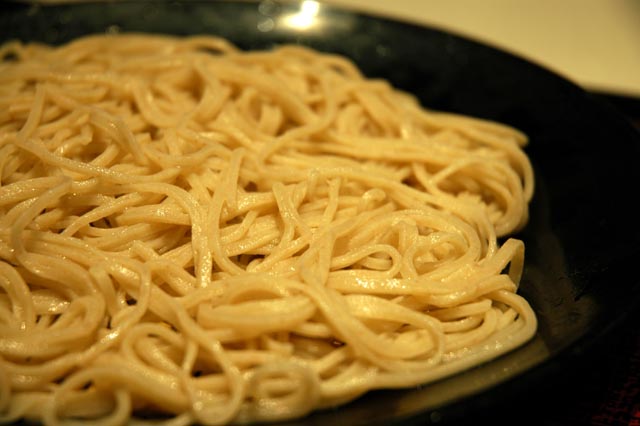
This picture alone should be sufficient to give you an idea of the quality of the soba they produce. You can see the rough 'homemade' texture, the result of a long preparation which includes making the flour itself! Most importantly, the noodles are cooked to perfection. Most other restaurants tend to overcook them, killing the soul of this delicate noodle. Soba must be removed from the heat at the right time, and immediately chilled in order to preserve its consistency.
The one above is 'seiro soba' ($12.20), served with chilled 'dashi' soup on the side, wasabi and spring onion to taste. This is the best way to taste soba at its purest.


This cold soba is a seasonal variety, called 'gomadare soba' ($19.80). The noodles are served in a chilled and creamy sesame seed based soup and topped with salmon sashimi, seasonal mushrooms, aubergines and Japanese vegetables. I was slightly skeptical of this new combination, but it was a truly enjoyable variation to the regular 'dashi' soup base.

The chilly/yuzu paste and spring onion served on the side add a real tangy, spicy twist to the otherwise calm flavour. I was happy with the whole serving mixed into my soba.

The bill came up to 47.65, including drinks and an extra side dish (tamagoyaki - $5.80).

Overall, Shimbashi soba remains one of my favourite restaurants. Their soba never disappointed me, with the only exception of the duck soba which used to be better than it has been recently (the duck is now overcooked and too tough). I highly recommend this place if you are in the area and you are looking for a quick, healthy meal.

For more information you can visit the company's website: http://www.res.com.sg/restaurants_view.php?v=5

Soup Restaurant - Seah Street

Who doesn't know what chicken rice is. Well, that's what soup restaurant is all about, together with their herbal soups. This is a well known chain of restaurants, with branches all over Singapore. I find that the Seah-street branch has more character. Located within a shop house, it offers that 'old school' environment which perfectly matches their cooking style.
Their philosophy is to serve 'Chinatown heritage cuisine', prepared in a traditional way. The Samsui chicken is their signature dish, and their menu narrates the full story of this truly Singaporean dish for those who haven't heard it before.


The steamed peanut snack ($4) is served as you sit at your table, but it's not complimentary. It's very well done, fragrant and soft.


A 'Samsui Ginger Chicken' portion for 4 people costs $26.80. Two layers of juicy, thick chicken chunks are arranged circularly around a large plate with the sauce served in the middle. This dish is not cheap when you consider that you can have chicken rice for a few dollars elsewhere in Singapore, but in my opinion the price is fully justified. The sauce, made from grated ginger and sesame oil, enhances the succulence of the chicken without obfuscating its flavour. You will find yourself dipping those generous chunks of chicken deeper and deeper into this addictive sauce. Lettuce is served on the side, so that you can wrap your seasoned chunks of chicken as you would do at a korean barbecue.

This beautiful 'Teochew olive rice' ($5.80) is a great substitute for your regular chicken rice. Although I disagree with the theory, every health conscious Singaporean will avoid chicken rice as it's notorious for being high in cholesterol. Olive rice doesn't feel oily, it has a very fragrant aroma, it looks beautiful and healthy and it tastes without covering other flavours (like a fried rice would do). It's the perfect combination to enhance your Samsui chicken experience.

The 'steamed San Yu fish slice' ($10.80) has a typical local flavour. Steamed fish slices, served on a bed of soy based sauce and topped with shredded spring onions and chilly. Although I like this dish, it's not what I would go to Soup restaurant for. I have tasted very similar versions of this dish at various other places around Singapore.

There is only one problem with Soup restaurant: that your neighborhood chicken rice stall will no longer taste the same.

Website: http://www.souprestaurant.com.sg/

Related Posts with Thumbnails